


Indica Books

Revealing the Art of Natyasastra
This book unveils the secret world of Indian classical theatre-the fundamental principles of sublime grace, stage presence, and effective communication of emotions. It analyzes the techniques of Centripetal Effect, Centre Point, and the Introspective Illusion that influence the presentation of plays. It also analyzes the secret of grace. Bharata Muni has given an unbelievably detailed study of the facial muscles and head movements. He orders What to do but not Why ?

Abhinaya Darpanam
Dance studies across genres require multiple approaches for an understanding of the sociological, phenomenological, political, cultural, philosophical and aesthetical practices that influences the dance's kinesthetic and existential character. In the context of Bharatanatyam, the moment of explaining shifting ideologies and its impact on the form, content and process, is a moment of convergence.

A Day in Kashi
Banaras a city with many mysteries, exquisitely depicted in colour. A selection of one hundred and eight photographs depicting a day in Kashi a day out of this world. Kashi, Banaras, Varanasi one of the most ancient of living cities. One can still trace its ancient background through the face it presents today. It is a city that unfolds its deepest secrets to only a few. A few who through dedication and love come time and time again to document the most inner and hidden secrets of this ancient city.

The Music of India
This is an attempt to bring, to bear a ''scientific'' attitude to Indian musicological problems. Tools and methods of modern science have been employed to probe into musical phenomena and Indian music history. No other term is perhaps so operatively basic as the tonic-drone in melodic music and today the tambura is the most important drone in Indian music. Importance of the emergence of the drone in Indian music history has been discussed at length, in terms of neuro-physiological dynamics.

A Practical Guide to North Indian Classical Vocal Music
This book is a step-by-step practical guide to North Indian music. With the help of this book, the reader can understand the basic aspects of North Indian music and learn to appreciate it better. It describes the ten basic ra.gs of North Indian classical music. It also gives instructions on how to sing and how to play the musical instruments. This book describes the tonal patterns and the tonal embellishments.
The Soul of India

The Lotus and The Lion
Buddhism is indisputably gaining prominence in the West, as is evidenced by the growth of Buddhist practice within many traditions and keen interest in meditation and mindfulness. In The Lotus and the Lion, the author traces the historical and cultural origins of Western Buddhism, showing that the British Empire was a primary engine for curiosity about and then engagement with the Buddhisms that the British encountered in India and elsewhere in Asia.
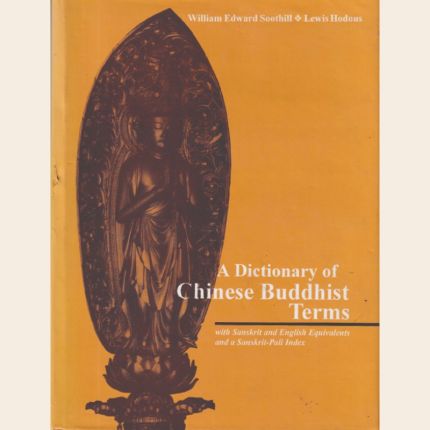
A Dictionary of Chinese Buddhist Terms
After the Dictionary went to press, Professor Soothill died. The work on the Dictionary, however, was completed. For ten years we worked together, he at Oxford and I at Hartfold, and the manuscript crossed the Atlantic four times. During his semester in New York as Visiting Professor in Columbia University and on my brief visit to Oxford, we had opportunity to consult together on some outstanding problems. The work of organizing the material and harmonizing the differences was done by Professor Soothill. He was well eequipped to undertake the task of producing a Buddhist Dictionary, having a thorough knowledge of the Chinese language.

Asoka Text and Glossary
The text and glossary are intended to provide the student of philology with a convenient handbook of Early Prakrit. The historian will find in this the ready means of checking various translations, sometimes misleading, of these important Indian documents of the third century B.C. The student of epigraphy must go to the Rocks and Pillars, or at least to estampages, photographs and plates-but in difficulties of interpretation he can find here for every Asokan form, as read up-to-date, all the passages where it occurs, or similar forms occur, with references to most at least of the literature on disputed forms.

Babur-Nama
The book in two volumes is a translation of Babur Padshah's Autobiography, made from the original Turki text. It truly embodies the career of the founder of the Mughal empire in India. It has the rare distinction of being contemporary with the events it describes. Babur-Nama has the complete record of Babur's life (1493-1529), when Babur ascended the throne at the young age of eleven to September 1529 where he had established himself as a monarch.

Buddhism
This book by a renowned Pali scholar is of great academic worth as it expounds the seminal ideas, key concepts and basic theories of Buddhist thought pertaining to dhamma and abhidhamma. It is a well thiught out work based on wide study and deep thinking of the concerned literature. It touches the kernel of Buddhist ethics and philosophy. According to Indian culture cosmic process and humanlife is teleological, purposive and goal-oriented.

SI-YU-KI
The reader who looks into the pages of this book will find ample material for study on some important questions; the different manners and customs of separate people, the various products of the different soils and the diverse class divisions of the society; when Buddhism flourished and when Buddhism declined as also how the devoted pilgrims encountered the perils of travel in foreign and distant lands and endured sufferings by desert, mountain and sea.