Shop

The Prosody of Pingala

The Ragas of Northern Indian Music
The first part of the book traces the history of Indian music and the continuity of its theory and practice for more than two thousand years. It is based on many years' research into the vast ancient Sanskrit literature of music. These valuable technical treatises, which lie in the form of scarcely catalogued manuscripts throughout the public and private libraries of India, had hitherto remained unemplored. Part Two transcribes and studies in detail fifty typical Raga-s. Each is preceded by a Sanskrit poem in translation which depicts the atmosphere; then follows an analysis of the scale, covering its intervals and expression, a study of the theme with its characteristic motives and finally a typical development.

The Ramayan of Tulsidas
The Ramayan, one of the most celebrated epics of the world, recounts the story of Rama, son of the King of Ayodhya, and their to the throne, who is banished from his home through the intrigues of his stepmother. Prince Rama, with his brother and his devoted wife Sita, spends fourteen years in exile. One day Sita disappears, abducted by a wicked demon named Ravana. Rama is despondent. After fruitless searching to find her whereabouts, he turns to a tribe of monkeys for help.

The Religion of India
Max Weber's early twentieth-century study of the religions and civilization of India is a great pioneering adventure in the sociology of ancient India. Weber's insight and analysis-especially his application of the sociological perspective to the work of classical Indologists and the religious texts available to him-were to add much to the store of the social scientist. Later, historians and archaeologist were to confirm a surprising number of Weber's theories.
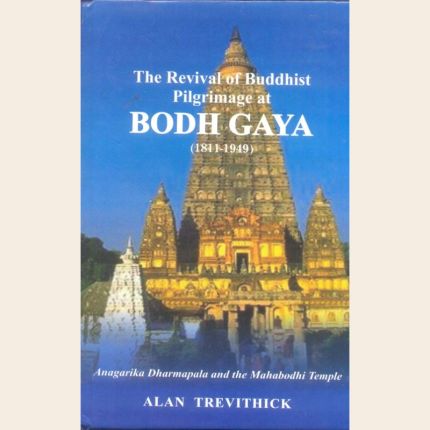
The Revival of Buddhist Pilgrimage at Bodh Gaya (1811-1949)
Alan Trevithick spent three years research primary documents in New Delhi, Sarnath, Colombo, and London, in order to present this history (1874-1949) of the Mahabodhi Temple at Bodh Gaya. This is the first such account, and it details for the first time the administrative, legal and legislative activities which shaped the temple's current status as one of the world's most popular pilgrimage sites. Also included is an innovative biographical essay on Anagarika Dharmapala, the Sinhalese activist who first came to India in the late 19th century as a guest of the Theosophical Society: his subsequent actions substantially affected the development of Bodh Gaya as a site of international importance.

The Rhythm of History
Arthur Osborne found that while academics investigated the causes of historical incidents, their research was limited, for the most part, to obvious physical causes, but they failed to clarify the overarching but hidden principles that, in his eyes, governed actions and made history. In this book he suggests a different approach to history, giving its due importance to spiritual ideas and teachers, and proposing that ideas shape the physical conditions of society more than the other way round. In his own words: "The purpose of the present book is not so much to suggest any new philosophy or interpretation of history as to draw attention to a rhythm that runs through it, establishing parallels and coincidences large and obvious enough not to be open to dispute. These will be sufficient at least to show that history is not purely haphazard and yet is also not simple progress."
Arthur Osborne observed that so-called progress was not what it appeared to be and that modern civilisation is not necessarily an advance on the discoveries and understanding that ancient civilisations had garnered and demonstrated in their development. He outlined the parallels--not be confused with uniformity--in the different phases through which the great civilizations of mankind passed. In the 18th century there was a radical divergence between the West and East, which is being overcome by the surging of a single world civilization.

The Ritual of Battle
This book is a study of India's great epic, the Mahabharata, against the background of Indo-European myth, epic and ritual. It builds upon the pioneering studies in these ares by Georges Dumezil and Stig Wikander to work toward the goal of understanding how this epic's Indo-European heritage is interpreted and reshaped within the setting of bhakti or devotional Hinduism.

The Sacred Complex of Kashi

The Sacred Marriage of A Hindu Goddess
Moving beyond traditional understanding of the catagory of ''sacred marriage'' derived from studies of the ancient Near East, Harman reveals that sacred marriage in India functions as a devotional metaphor for Hindu devotees, a way understanding how deities act toward one another and toward who worship them. Combining sdystematic textual study with descriptive fieldwork, Harman offers us an original and perceptive exploration of the relationship between the human and the divine in Hindu life.

The Sakta Pithas
The sakta pithas by Dr D. C. Sircar, which is limited and precise in scope but has a wide appeal, brings honour to the young historian of Calcutta. Its basis is a critical edition of the Pithanimaya or Mahapithanirupana which is short treatise of the late period describing the fiftyone pilgrim spots associated with the Mother Goddess under some of her various names. Each one of the pithas is mentioned along with a particular form of the Goddess and that of siva associated with it.

The Sankhya Aphorisms of Kapila
The present translation of Aphorisms of Kapila by J.R. Ballantyne is so rendered as to make it possible for an average reader to understand the complex thought structure of Sankhya philosophy in a language that is easy and graspable. It will be of great help to those who are desirous of knowing not only the historical background of Indian thought, but also want to know as to how existential questions of life and death have been tackled.