


Indian Philosophy


Saundaryalahari of Sankaracarya
The Saundaryalahari has fascinated and puzzled generations of scholars and laypersons; subject to continuing study and debate, till today, such details as the authorship of the 100 verses named the Saundaryalahari remain a matter of contention, particularly among scholars.
Nataraja Guru worked on the translation and commentary of the Saundaryalahari for a period of three and a half years, it is his last work and comes at the end of a life dedicated to the pursuit of the Absolute and those familiar with his work will recognize in it a kind of summing up of his life and teachings.
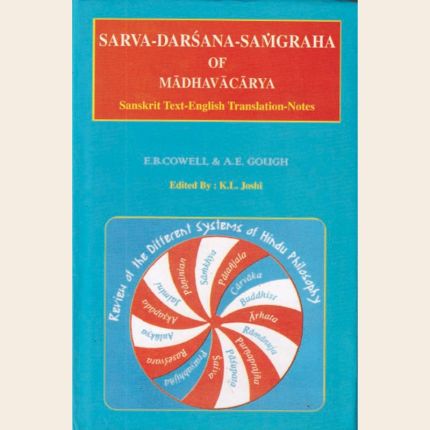
Sarva-Darsana-Samgraha of Madhavacarya

A Course in Indian Philosophy
Indian Philosophy its content is of course completely irrelevant to the world of greed and money-making which has replaced the remarkably idealistic societies emerging from the crucible of death and destruction in the Second World War. Then. the surviviors were glad to be alive and wanted to fill the mourning world with new joy, not with money.

The Sankhya Aphorisms of Kapila
The present translation of Aphorisms of Kapila by J.R. Ballantyne is so rendered as to make it possible for an average reader to understand the complex thought structure of Sankhya philosophy in a language that is easy and graspable. It will be of great help to those who are desirous of knowing not only the historical background of Indian thought, but also want to know as to how existential questions of life and death have been tackled.

The Tarkabhasa of Kesavamisra
Tarkabhasa, a text, presents a detail discussion on Nyaya theory. It is known as an elementary treatise, a key for the beginners of the Science of Nyaya. It is quiet evident that Tarkabhasa is written by Kesava Misra, as mentioned at the end of the text. It presents the subject matter in an easy language.

Navya-Nyaya Philosophy of Language
This book represents the philosophy of language in Navya-Nyaya, based upon an analysis of the ''Verbal Suffix Chapter'' of Gangesa's Tattvacintamani. Since this chapter elaborates what kind of verbal understanding is generated and discusses related issues, the book demonstrates the main features of that philosophy of language and serves as a good introduction to that. The analysis mainly deals with Gangesa, but in some cases it referes to Raghunatha. Since the book is an attempt to pursue philological exactness and philosophical analysis, it is hoped to interest not only Sanskrit scholars, but also philosophers in general.

Life and Teachings of Adi Sankaracarya
This book is intended for scholars, students and general readers. Accordingly, the early researches on the date and works of Sankara have been brought out in detail. Not only Sankara's commentaries on the Upanisads, Bhagavad Gita and the Brahma Sutra but also the books attributed to him, especially the minor works (prakarana granthas) and hymns (stotras), have been narrated purposefully for the sake of students and general readers.

The Philosophy of the Bhagavadgita
This scholarly work presents a comprehensive and authentic exposition of the philosophy of the Bhagavadgita enshrined in the original text by according due consideration to the commentaries of Samkara, Ramanuja and Madhva. In the first part of the book, Dr. Chari makes an indepth study of the selected verses from each adhyaya and discusses their philosophical implications with particular reference to the Vedanta doctrines and connected issues advanced by the commentators while interpreting the crucial verses.

The Supreme Yoga : Yoga Vasistha
The Yoga Vasistha has been a favourite book of spiritual seekers in India these several centuries. Its special appeal lies in its thoroughly rational approach, and in its presentation of Vedanta as a philosophy to bridge the gulf between the secular and the sacred, action and contemplation, in human life, through a comprehensive and lofty spirituality.
The Heritage of Sankara
