


Advaita Vedanta

Vedanta
This volume presents in a clear and concise form the tents of a religion, the scriptures of which have evolved over the course of five thousand years. Vivekananda once said, ''I have a message to the West, as Buddha had a message to the east.'' And the message was Vedanta. As Christopher Isherwood says in his foreword:'' It must be remembered that much of this material was first spoken to audiences - sometimes extemporaneously, without even a rough draft of what Vivekananda wished to say. In such cases, it was taken down in shorthand ... Thus we experience the freshness of the Swami's live speech. Vivekananda's living presence often becomes powerfully evident behind his words."

Bhasa Pariccheda
The Bhasa-Pariccheda with its commentary, the Siddhanta-muktavali, by the same author, Visvanatha Nyaya-Pancanana Bhattacarya, is a manual on the Nyaya-Vaisesika Philosophy which is extensively read throughout India by all who want to get a fair knowledge of the subject within a short compass. Through inteded for beginners, it is a pretty difficult book, the chief reason for which is its extreme terseness. In 1850 Dr. E. Roer published an English edition of the Bhasa-pariccheda, with extracts from the Muktavali, which is long out of print. An English rendering of the work with the Muktavali was therefore overdue.

The Vibrating Universe
The Vibrating Universe synthesizes the superstring theory of modern physics and the vibration concept of Advaita Vedanta and Kashmiri Saivism. The Philosophical problem of monism versus pluralism, as given in Indian philosophy, Western philosophy and classical as well as modern science, has been analytically presented. In this attempt, dualism and pluralism have been rejected, and non-dualism has been re-established.

A Tradition of Teachers Sankara and the Jagadgurus Today

Theory of Karma
The ancient Vedantic knowledge reinforced by Brahmasutra and Bhagavadgita establish that it is, purely and solidly, the result (karmaphala) of earlier actions (karmas) of each one of the sentient entities. This is a strong and formidable solution to the unanswered questions like why does, one child being blessed to be born in either rich or healthy and sattvic family and another child being consigned to be born in a family living in poor conditions or unhealthy tamasic environment.
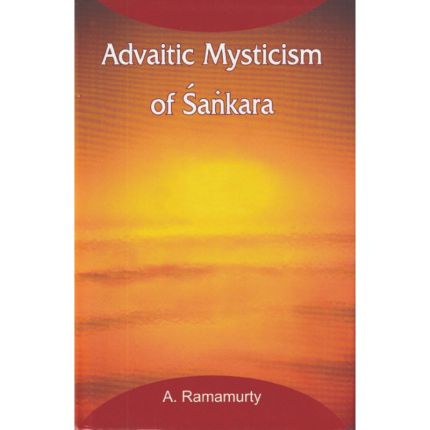
Advaitic Mysticism Of Sankara
This book attempts to elaborate and clarify Sankara's understanding of brahmannubhava, in all its aspects, relying exclusively on his own writings. For this, not only the commentaries, but also the prakarana granthas have been taken into account. In the final chapter, brahmanubhava is compared with what was said about the mystic experience by two of the most authoritative exponents of christian and Islamic mysticisms, namely st, John of the cross and Jalalu' d-Din Rumi, mainly to understand Sankara's position without any ambiguity.

Advaita Metaphysics
This book undertakes the study of Advaitavada of sankara in its depth and extension. It spells out the relative cogency of Malkani's understanding of Advaita Metaphysics and Methodology, Murty's Critique of Advaita (nondualism) and Misra's Philosophical Construction of Advaita from a linguistic perspective. This volume centres around the formulations of the Advaita theory of monism on the basis epistemological and logical analysis of knowledge in Adhyasa Bhasya.

Brahman and the World
This book proposes to take up the question of Universal Causation to examine thoroughly as how far it is right to regard Brahman as the Universal Cause and how far sutrakara himself lent his support to each of the interconflicting schools of Vedanta. This book should, therefore, benefit all who are devoted to the philosophic teachings of Advaita Vedanta and its preceptors.
Mind-Body Dualism

Advaita A Conceptual Analysis

Indian Philosophical Wisdom
The title of the book Indian Philosophical Wisdom: some Glimpses itself signifies its importance. Ineed, Philosophy is involved in every sphere of human life - literature, creative art, culture, etc. The author in her zeal to unravel the precious accumulated wisdom of Indian Philosophy delved in its treasure with different approaches - historical, analytical, comparative, etc. An attempt has been made in this book to expound Indian Philosophical systems and to analyse critically their logical implications.

Integrating Interdisciplinarity through Philosophy
The books delves into the idea and the philosophy of interdisciplinarity, and then unravels the genealogy, dynamics, and myriad configurations of the highly complex phenomenon. It goes on to assess impact, advantages and critical issues involved in interdisciplinarity, while outlining an Indian view of it. The book, thus, explores the conceptual connections, fundamental issues and intrinsic implications of a myriad variety of interdisciplinary study and research, within and beyond academia. The book also attempts to develop necessary theoretical perspectives and a broader conceptual framework in this connection.