


Default

Asoka Text and Glossary
The text and glossary are intended to provide the student of philology with a convenient handbook of Early Prakrit. The historian will find in this the ready means of checking various translations, sometimes misleading, of these important Indian documents of the third century B.C. The student of epigraphy must go to the Rocks and Pillars, or at least to estampages, photographs and plates-but in difficulties of interpretation he can find here for every Asokan form, as read up-to-date, all the passages where it occurs, or similar forms occur, with references to most at least of the literature on disputed forms.

Babur-Nama
The book in two volumes is a translation of Babur Padshah's Autobiography, made from the original Turki text. It truly embodies the career of the founder of the Mughal empire in India. It has the rare distinction of being contemporary with the events it describes. Babur-Nama has the complete record of Babur's life (1493-1529), when Babur ascended the throne at the young age of eleven to September 1529 where he had established himself as a monarch.

Buddhism
This book by a renowned Pali scholar is of great academic worth as it expounds the seminal ideas, key concepts and basic theories of Buddhist thought pertaining to dhamma and abhidhamma. It is a well thiught out work based on wide study and deep thinking of the concerned literature. It touches the kernel of Buddhist ethics and philosophy. According to Indian culture cosmic process and humanlife is teleological, purposive and goal-oriented.

SI-YU-KI
The reader who looks into the pages of this book will find ample material for study on some important questions; the different manners and customs of separate people, the various products of the different soils and the diverse class divisions of the society; when Buddhism flourished and when Buddhism declined as also how the devoted pilgrims encountered the perils of travel in foreign and distant lands and endured sufferings by desert, mountain and sea.

Domain of Lord Jagannath
This little book, entitled Domain of Lord Jagannath -A Historical Study by Dr. Bikram Das, a medical professor, is a unique work in the field of cultural history relating to Lord Jagannath and the Thakur Raja of Puri. It describes how the glorious administration of the sixteenth century developed in Purushottama-dham and how the Gajapati Rajas were respected by Rajas, Zamindars and people of Orissa even after they were deprived of power and independence.
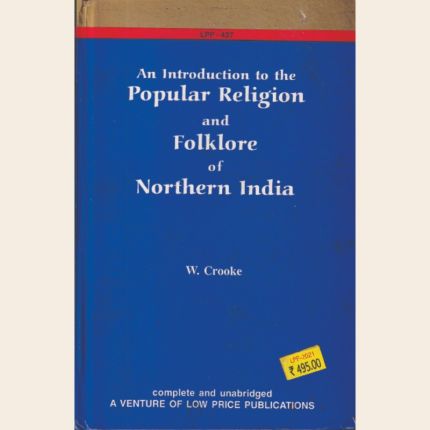
An Introduction to the Popular Religion and Folklore of Northern India

Skanda-Karttikeya

Universal History of Music
Music pervades all nature. There is nothing in nature that arouses our attention of effects our feelings so quickly as a sound. The book furnishes an account of the music of various nations-civilized to uncivilized, on the faces of the habitable globe. A few facts concerning Hindu music are given a place in the Appendix.

Perspectives in Social and Economic History of Early India
The book begins with a survey of the sources of the social and economic history of early India, and reviews the writings from the late ninteenth to the mid-twentieth centuries on social history. It discusses the problems of caste and gender relations, and shows the role of divination and communication in fostering social control and cohesion.

Man and His Becoming
Richard C. Nicholson's translation of Rene Guenon's Man and His Becoming is an exposition of the 'nature and constitution of the human being' in the light of the doctrines of Vedanta which echoes the Upanishadic message, 'there is one only without a second.' Other traditional views like Nyaya, Vaisesika, Sankhya, Yoga and Mimamsa are referred to wherever necessary.

Indian Philosophical Systems
Vedanta Desika, an illustrious successor to Ramanuja, wrote two important philosophical treatises titled Tattva-mukta-kalapa and Adhikarana-saravati, devoted primarily to establish that Visistadvaita Vedantais a sound system of philosophy. He also contributed another important philosophical work under the title Paramata-bhanga in which he presents a critical review of the main tenets of sixteen schools of thought covering.

The Religion of India
Max Weber's early twentieth-century study of the religions and civilization of India is a great pioneering adventure in the sociology of ancient India. Weber's insight and analysis-especially his application of the sociological perspective to the work of classical Indologists and the religious texts available to him-were to add much to the store of the social scientist. Later, historians and archaeologist were to confirm a surprising number of Weber's theories.