


Default

Siva Sutras
Siva Sutras : The Supreme Awakening, is revealed by the twentieth century's great philosopher saint Swami Lakshmanjoo. This spiritual treasure, gifted by God to the sage Vasugupta for the upliftment of humankind, is considered to be one of Kashmir Shaivism's most important scriptures. Here, Swami Lakshmanjoo gives the reader a penetrating vision of the glorious journey of the Supreme Awakening; the traveling from limited individuality to absolute oneness with God.

Siva Sutras
Siva Sutras are considered to be a revealed book of the Yoga : supreme identity of the individual self with the divine. Here an English translation of the Siva Sutras has been provided, together with the commentary of Ksemaraja. A long introduction, together with an abstract of each sutra, throws a flood of light on the entire system of Saiva Yoga. A glossary of technical terms and index are appended for the convenience of the reader.

Sivastotravali of Utpaladeva
Sivastotravali is a collection of hymns dedicated to Lord Siva by Acarya Utpaladeva, a great Saivite master intensely in love with Lord Siva and earnestly craving to be one with Him. The book comprises 450 verses arranged in twenty chapters. Each verse is soaked in the nectar of his intense devotion for the Lord and extreme craving for God-consciousness. The book represents his direct and uninhibited one-way dialogue with Lord Siva, projecting his problems, one at a time and seeking His indulgence in getting over these.

Six Vedic Systems of Indian Philosophy
This book professes to be no more than a description of some of the salient points of each of the six systems of Indian philosophy. It does not claim to be exhaustive. It is calculated to appeal to the beginners and to arouse their curiosity in the subject. I hope that this presentation of the fundamental tenents of the six systems of Indian philosophy will be superseded by a more comprehensive examination of Indian philosophy.

Skanda-Karttikeya

Solve Your Problems Astrologically
A unique publication on Hindu astrology which exposes everyday human problems like education, sex, marriage, job, finance, ill-health and death in the most revealing manner. If you have a problem, the book will dissolve it and disclose interesting features of your life. Those interested in practical side of yoga, meditation and rational approach to life will be taken to unprecedented heights of cosmic unfoldment.

Solve Your Problems Astrologically

Soma in Yoga and Ayurveda
The secret of Soma, the legendary mystic drink of immortality, first lauded by India's ancient Vedic seers ? Is Soma a single plant, a type of plants, a way of healing, a special intoxicant, or an inner elixir produced by Yoga and meditation ? Going back to the vision of the Vedic seers, David Frawley reveals the secret of Soma for body, mind and spirit, with its profound implications from diet and herbs to pranayama, mantra and meditation.
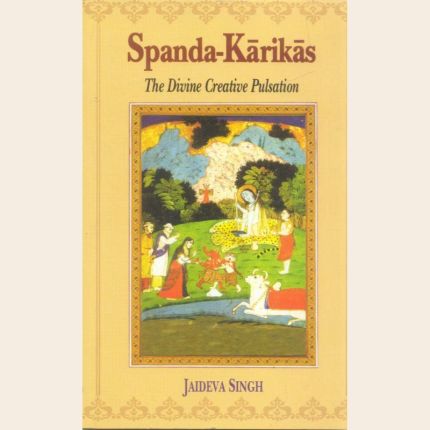
Spanda-Karikas

Speaking of Dance
The book highlights how these time-honoured writing have contributed to the evolution of classical dancing in India. And, yet more significantly perhaps, the author ventures into a comparatively uncharted terrain seeking to explore the status of performing arts (including dance) in early Jain tradition. Focusing on the position of dancing in the contemporary cultural life of India, Mandakranta Bose shows how classical dance in India today has achived a creative blend of tradition and modernity, leading to a vigorous revival of a great heritage, a part of the larger effort towards 'nationalist rediscovery'.

Spandapradipika A Commentary on the Spandakarika by Bhagavadutpalacarya
The Spandapradipika is a commentary on the Spanda Karika, an early, seminal Kashmiri Saiva text. This commentary is by Bhagavadutpala, also known as Utpala Vaisnava, who lived in 10th century Kashmir. It is important both because it is early and especially because it contains copious references to Pancaratra sources--the earliest dateable ones so far recovered. Mark Dyczkowski has translated this text in his book Stanzas on Vibration. The Spandakarika with Four Commentaries.