


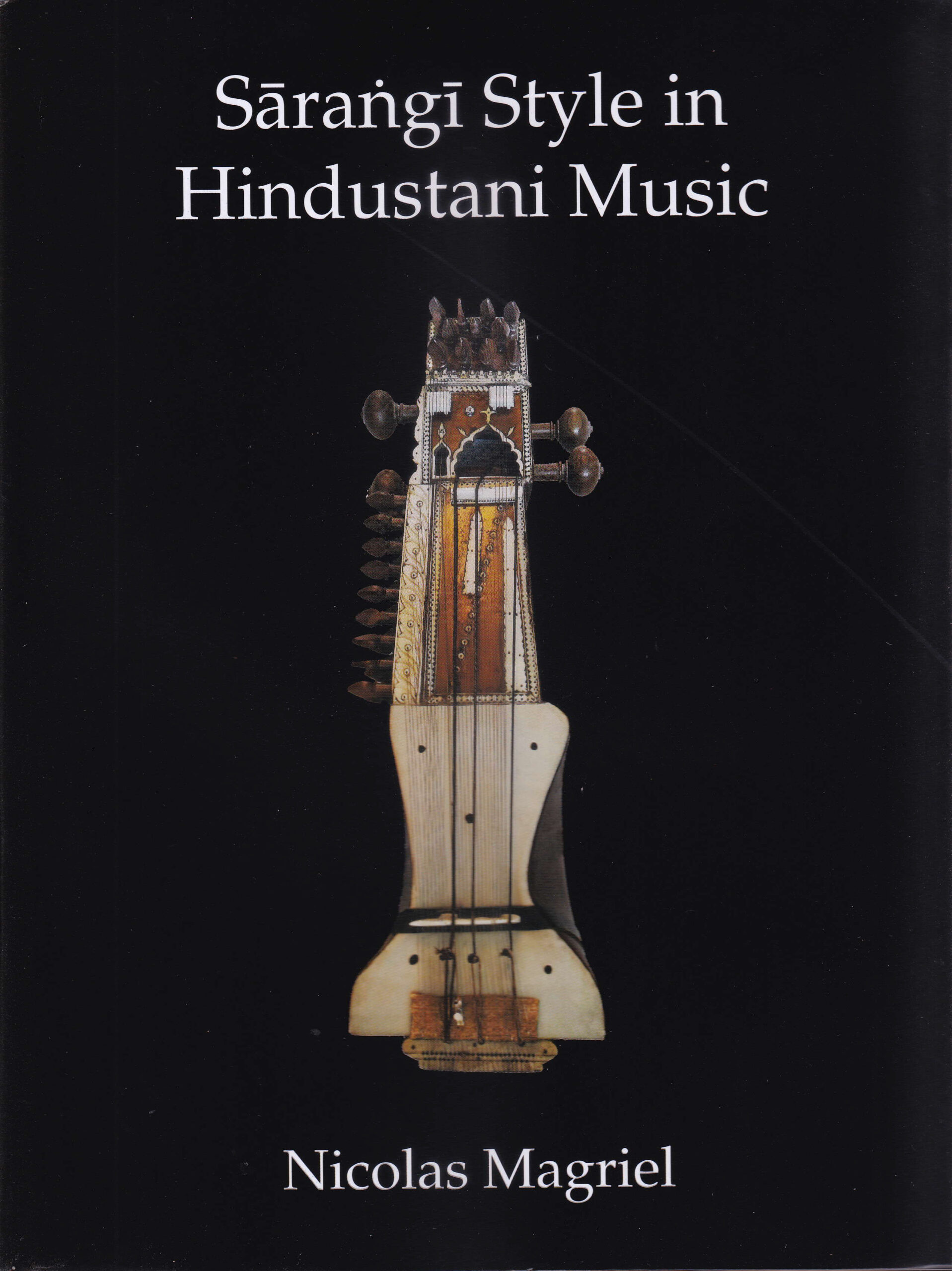
Sarangi Style in Hindustani Music
₹1,950
| Author, Editor or Translator | Nicolas Magriel |
|---|---|
| Bound | HB |
| Country of origin | India |
| Number of Pages | 585 |
| Publisher | INDICA BOOKS |
| Weight and Dimension | 1760g 29 X 22.5 X 4 Cm. |
| Language | English |
| ISBN | 9789381120408 |
In stock
Description
This is the most complete book on any Indian instrument.
The sarangi is the main bowed instrument of Hindustani music. It has three gut melody strings that are stopped by the left-hand cuticles or the skin above the nails. Around 36 sympathetic strings give a hauntings echo. Traditionally the sarangi’s public role has been to provide melodic accompaniment for vocal music, but its players have always practised and performed solo sarangi in their homes and at musicians’ gatherings. The constraints posed by the sarangi’s unusual construction and technique have given birth to a unique instrumental manifestation of vocal music that has never before been examined in a musicological work.
This beautifully illustrated book attempts to answer these questions: What is sarangi music? In what ways does it reflect or differ from the vocal music on which it is based? In what ways do the unique features of the sarangi and its technique affect its capacity to emulate vocal music? The approach is empirical, supported by extensive sargam transcription and analysis of video-recorded music and informed by the author’s fifty years of experience as a student, performer and teacher of the sarangi and Hindustani vocal music. The discussion is supplemented by 170 online video files and 555 audio examples. Most of these materials are supplied in both normal-speed and half-speed versions.
For sale only in South Asia
Only logged in customers who have purchased this product may leave a review.
Related products

A Practical Guide to North Indian Classical Vocal Music
This book is a step-by-step practical guide to North Indian music. With the help of this book, the reader can understand the basic aspects of North Indian music and learn to appreciate it better. It describes the ten basic ra.gs of North Indian classical music. It also gives instructions on how to sing and how to play the musical instruments. This book describes the tonal patterns and the tonal embellishments.


Hindustani Music Today
Stating that Hindustani music should be rightly termed ''Art music'' and not ''classical music'', the book begins by discussing the features of Art music and presents an approach to appreciating Hindustani music. It provides a detailed understanding of the components of the raga experience in Hindustani music, including their time theory and the role of Gharanas of the musical tradition.


Music of the Nations
The Music of the Nations is a comparative study of music and musical systems of the civilized nations of the world. Besides, music of India was not limited within the corners of India, but it crossed the borders of India, and contributed her art and culture to other countries. The Buddhist age was a golden one, and in this age, India had a contact with Mesopotemia.
Sitar and Its Music
Sitar and Its Music is a revised and enlarged edition of a much sought after reference book on instrumental music, appeared as Sitar and its Techniques, in 1981. It is a serious attempt to convey the basic principles and allied information on sitar and its music, keeping in mind its absolute usefulness for the students who want to learn sitar and our great tradition.The book vividly deals with gharana, especially its contribution to the existing and traditional Indian classical music.

The Grammar of Carnatic Music
This book argues that Carnatic music as it is practiced today can be traced to the musical practices of early/mid-eighteenth century. Earlier varieties or ''incarnations'' of Indian music elaborately described in many musical treatises are only of historical relevance today as the music described is quite different from current practices.

Reviews
Clear filtersThere are no reviews yet.