


Indian Philosophy

The Concept of War
War makes life miserable for both the praties involved, the invader and invaded. No war is fought without losing men and material, stripping off societal life and political order. Simultaneously it contributes to the progress of the society and preserves the liberty and honour of a state. From the Vedic period of India and the epic period of Greece, we have records of wars, and deliberations on the logic, Philosophy, Politics, ethics, strategies (pre- and post-war) of war, and the ways of reconstructing the war-ravaged societies, paving the way for drastic social and economic changes.

The Fundamentals of Advaita Vedanta

The Heritage of Sankara

The Philosophy of the Bhagavadgita
This scholarly work presents a comprehensive and authentic exposition of the philosophy of the Bhagavadgita enshrined in the original text by according due consideration to the commentaries of Samkara, Ramanuja and Madhva. In the first part of the book, Dr. Chari makes an indepth study of the selected verses from each adhyaya and discusses their philosophical implications with particular reference to the Vedanta doctrines and connected issues advanced by the commentators while interpreting the crucial verses.
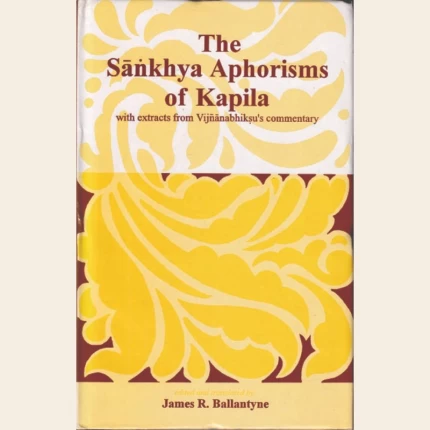
The Sankhya Aphorisms of Kapila
The present translation of Aphorisms of Kapila by J.R. Ballantyne is so rendered as to make it possible for an average reader to understand the complex thought structure of Sankhya philosophy in a language that is easy and graspable. It will be of great help to those who are desirous of knowing not only the historical background of Indian thought, but also want to know as to how existential questions of life and death have been tackled.

The Sankhya Philosophy

The Supreme Yoga : Yoga Vasistha
The Yoga Vasistha has been a favourite book of spiritual seekers in India these several centuries. Its special appeal lies in its thoroughly rational approach, and in its presentation of Vedanta as a philosophy to bridge the gulf between the secular and the sacred, action and contemplation, in human life, through a comprehensive and lofty spirituality.

The Tarkabhasa of Kesavamisra
Tarkabhasa, a text, presents a detail discussion on Nyaya theory. It is known as an elementary treatise, a key for the beginners of the Science of Nyaya. It is quiet evident that Tarkabhasa is written by Kesava Misra, as mentioned at the end of the text. It presents the subject matter in an easy language.

The Vedanta Doctrine of Sri Sankaracarya

The Vibrating Universe
The Vibrating Universe synthesizes the superstring theory of modern physics and the vibration concept of Advaita Vedanta and Kashmiri Saivism. The Philosophical problem of monism versus pluralism, as given in Indian philosophy, Western philosophy and classical as well as modern science, has been analytically presented. In this attempt, dualism and pluralism have been rejected, and non-dualism has been re-established.

Theories of Knowledge

Theory of Karma
The ancient Vedantic knowledge reinforced by Brahmasutra and Bhagavadgita establish that it is, purely and solidly, the result (karmaphala) of earlier actions (karmas) of each one of the sentient entities. This is a strong and formidable solution to the unanswered questions like why does, one child being blessed to be born in either rich or healthy and sattvic family and another child being consigned to be born in a family living in poor conditions or unhealthy tamasic environment.