


Advaita Vedanta

The Supreme Yoga : Yoga Vasistha
The Yoga Vasistha has been a favourite book of spiritual seekers in India these several centuries. Its special appeal lies in its thoroughly rational approach, and in its presentation of Vedanta as a philosophy to bridge the gulf between the secular and the sacred, action and contemplation, in human life, through a comprehensive and lofty spirituality.

The Heritage of Sankara

Advaita Metaphysics
This book undertakes the study of Advaitavada of sankara in its depth and extension. It spells out the relative cogency of Malkani's understanding of Advaita Metaphysics and Methodology, Murty's Critique of Advaita (nondualism) and Misra's Philosophical Construction of Advaita from a linguistic perspective. This volume centres around the formulations of the Advaita theory of monism on the basis epistemological and logical analysis of knowledge in Adhyasa Bhasya.

Blissful Experience Bhakti

The Fundamentals of Advaita Vedanta

Brahman and the World
This book proposes to take up the question of Universal Causation to examine thoroughly as how far it is right to regard Brahman as the Universal Cause and how far sutrakara himself lent his support to each of the interconflicting schools of Vedanta. This book should, therefore, benefit all who are devoted to the philosophic teachings of Advaita Vedanta and its preceptors.

The Vibrating Universe
The Vibrating Universe synthesizes the superstring theory of modern physics and the vibration concept of Advaita Vedanta and Kashmiri Saivism. The Philosophical problem of monism versus pluralism, as given in Indian philosophy, Western philosophy and classical as well as modern science, has been analytically presented. In this attempt, dualism and pluralism have been rejected, and non-dualism has been re-established.
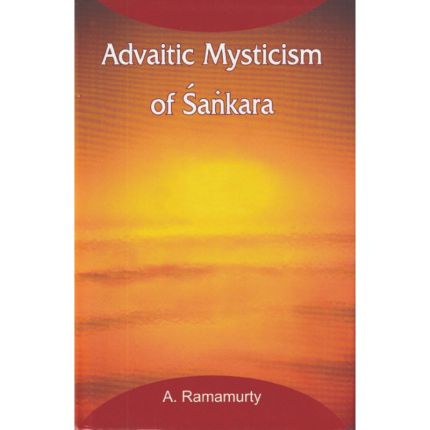
Advaitic Mysticism Of Sankara
This book attempts to elaborate and clarify Sankara's understanding of brahmannubhava, in all its aspects, relying exclusively on his own writings. For this, not only the commentaries, but also the prakarana granthas have been taken into account. In the final chapter, brahmanubhava is compared with what was said about the mystic experience by two of the most authoritative exponents of christian and Islamic mysticisms, namely st, John of the cross and Jalalu' d-Din Rumi, mainly to understand Sankara's position without any ambiguity.

Indian Philosophical Systems
Vedanta Desika, an illustrious successor to Ramanuja, wrote two important philosophical treatises titled Tattva-mukta-kalapa and Adhikarana-saravati, devoted primarily to establish that Visistadvaita Vedantais a sound system of philosophy. He also contributed another important philosophical work under the title Paramata-bhanga in which he presents a critical review of the main tenets of sixteen schools of thought covering.

Saundaryalahari of Sankaracarya
The Saundaryalahari has fascinated and puzzled generations of scholars and laypersons; subject to continuing study and debate, till today, such details as the authorship of the 100 verses named the Saundaryalahari remain a matter of contention, particularly among scholars.
Nataraja Guru worked on the translation and commentary of the Saundaryalahari for a period of three and a half years, it is his last work and comes at the end of a life dedicated to the pursuit of the Absolute and those familiar with his work will recognize in it a kind of summing up of his life and teachings.

Indian Philosophical Wisdom
The title of the book Indian Philosophical Wisdom: some Glimpses itself signifies its importance. Ineed, Philosophy is involved in every sphere of human life - literature, creative art, culture, etc. The author in her zeal to unravel the precious accumulated wisdom of Indian Philosophy delved in its treasure with different approaches - historical, analytical, comparative, etc. An attempt has been made in this book to expound Indian Philosophical systems and to analyse critically their logical implications.

Theory of Karma
The ancient Vedantic knowledge reinforced by Brahmasutra and Bhagavadgita establish that it is, purely and solidly, the result (karmaphala) of earlier actions (karmas) of each one of the sentient entities. This is a strong and formidable solution to the unanswered questions like why does, one child being blessed to be born in either rich or healthy and sattvic family and another child being consigned to be born in a family living in poor conditions or unhealthy tamasic environment.